
Quick Answer
A reversible chaise sofa has an extended lounging section that can be moved from left to right, depending on the design. It gives homeowners more freedom to change their living room layout without buying another sofa. Before purchasing, check the conversion method, dimensions, cushion support, upholstery, and available floor space. I will explain everything in a simple way so you can avoid wasting money and choose the right design.
Author Box
Author: Tanzeela
Role: Publisher and Furniture/Home Interior Writer
Experience: Dedicated researcher and furniture writer specializing in home interiors, layout planning, and couch comfort guides.
Content Review: This guide is based on furniture-buying principles, manufacturer information, and practical room-planning guidance to help readers make informed decisions. My goal is not to sell furniture but to provide readers with the right advice according to their home space.
Introduction

A reversible chaise sofa can make your living room more comfortable without limiting you to just one furniture arrangement. Unlike a traditional sofa with a fixed chaise, this flexible design allows you to move the extended lounging section to the other side when the room layout or your needs change.
Imagine buying a beautiful sofa for your apartment, only to discover later that the chaise blocks the doorway or leaves too little space for walking. People often make these mistakes when they rush their decisions, so I have created this detailed guide to help you make your living room look its best. You might love the sofa’s color and cushions, but the wrong configuration can make your entire living room feel awkward. If the model genuinely supports both arrangements, a reversible design can help you avoid this problem.
However, not every sofa advertised as reversible works in the same way. Some models have a movable ottoman and a long cushion, while others have detachable sections or adjustable components. Understanding these differences can help you avoid spending money on flexibility that you do not actually get.
This guide explains how reversible chaise sofas work, when they are suitable, how to measure your room, which materials deserve attention, and what to inspect before buying. You will also learn how to keep your sofa clean, avoid common buying mistakes, and choose a design that fits your daily routine.
No matter if you are setting up a compact apartment, decorating a cozy family zone, or relocating soon, your main focus remains the same: select a couch that complements your layout, offers great body support, and stays highly functional for years.
What Makes a Reversible Chaise Sofa Different?
How a Reversible Chaise Sofa Works

A reversible chaise sofa combines regular seating with an extended section designed for stretching out. Its main difference is that the extended section can be moved to the other side after purchase, provided the sofa’s construction supports this change.
A standard fixed-chaise sofa has a permanent layout. If the chaise is attached to the left side, you generally cannot move it to the right unless you replace the furniture or make changes that the manufacturer does not support.
A reversible chaise sofa offers more flexibility. Depending on the model, you may reposition an ottoman, move a separate chaise section, or rearrange compatible modules. Always read the product instructions because the word “reversible” does not describe one universal mechanism.
Check the Sofa’s Actual Configuration
For example, a sofa may look reversible in its product photographs, but the manufacturer might sell separate left-facing and right-facing versions. These are two different configurations, not necessarily one reversible product.
The following differences can help you make the right decision while shopping:
- Fixed chaise sofa: The extended section stays on one side.
- Reversible chaise sofa: Its design allows you to move the lounging section to either side.
- Modular sectional: You can move its separate sections around to create different seating arrangements, depending on the design.
- Sofa with a movable ottoman: Its separate footrest can extend the lounging area, though it may not connect to the sofa like a proper chaise section.
Who Benefits Most From a Reversible Chaise Sofa?
A reversible chaise can be especially useful for people who live in rented homes, move frequently, or enjoy changing their furniture arrangement. It can also help when you have not finalized the positions of your television, reading corner, or other living room furniture.
However, flexibility should not be your only buying priority. If a reversible sofa has uncomfortable cushions or weak connectors, the ability to move the chaise will not make it a good purchase.
Focus on three things: a conversion system supported by the manufacturer, comfortable seating, and construction that suits your daily use.
Main Benefits of a Sofa With Reversible Chaise
Flexible Living Room Arrangements
The biggest advantage of a reversible chaise sofa is adaptability. Instead of choosing furniture that permanently determines your room layout, you can adjust the seating arrangement according to your available space.
It helps you change your room layout. You might initially place the chaise beside a window, then move it to the opposite side when you change the television’s position or add a reading lamp. If the sofa supports both arrangements, you can change the layout without replacing the entire sofa.
It can make future moves easier. A sofa that works in more than one configuration may also suit a new home with a different room shape. However, flexibility does not guarantee that the sofa will fit everywhere. Before moving, check both configurations against your new room’s dimensions.
Comfort and Practical Everyday Use
It creates a comfortable lounging area. The extended seat allows you to stretch your legs while reading, watching television, or relaxing. The chaise gives you a comfortable place to stretch your legs without needing a separate footstool. However, it still takes up floor space, so measure your room carefully before choosing a sofa.
It helps organize an open-plan room. An L-shaped seating arrangement can separate the living area from the dining space without adding a physical partition. Position the sofa so it defines the seating zone without blocking the main walking route.
It offers styling flexibility. You can move the chaise to balance the room around a rug, coffee table, window, or focal wall. This flexibility can be useful when your decorating style changes over time.
Limitations to Consider Before Buying
Nevertheless, reversible furniture has some limitations. Some models require you to lift several heavy pieces, change connectors, or move cushions. An ottoman with poor support may also shift during use.
Before buying, ask how the conversion works, whether tools are required, and whether the manufacturer provides instructions for both arrangements. If possible, test the mechanism in a showroom.
For more ideas about seating styles, explore CozySofaHub’s guide to small chaise sofa designs.
How to Choose the Right Sofa Size and Layout
A reversible chaise sofa needs more planning than a standard sofa because changing the position of its extended section also changes how you use the available floor space.
Start by measuring your room instead of estimating from a product photograph. Record the available wall length, the distance between the sofa and the opposite wall, and the space required for doors, drawers, and walkways.
Next, check the sofa’s complete dimensions. You need its total width, standard depth, chaise depth, and height. If the chaise can move to the other side, confirm that both arrangements fit your room.
Use the Floor-Tape Test
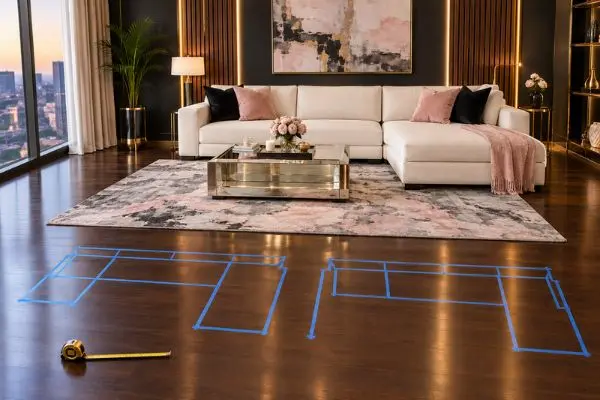
This simple room-planning exercise can help you avoid an expensive mistake.
- Measure the sofa according to the manufacturer’s dimensions.
- Mark the sofa’s complete footprint on the floor using painter’s tape.
- Mark the extended chaise area in the first configuration.
- Create another outline for the second configuration.
- Walk through the room as you normally would.
- Open nearby doors and drawers, and check access to windows, electrical outlets, and other furniture.
Leave enough space for comfortable movement. Around 30–36 inches is a useful starting point for a main walkway, although your room and furniture arrangement may require more or less space. For a coffee table, a gap of roughly 16–18 inches from the seat edge can also be a practical starting point. Treat these measurements as planning guidelines rather than strict building rules.
| Room Type | Key Consideration | Recommendation |
| Small apartment | Chaise depth and walking routes | Choose a compact model that keeps the walking path clear |
| Narrow living room | Distance between the sofa and opposite wall | Compare both chaise positions before ordering |
| Open-plan room | Access to the dining area and room boundaries | Use the chaise to define the lounge area without blocking movement |
| Family room | Seating capacity and daily movement | Prioritize durable upholstery and stable connections |
| Rented home | Future layouts and delivery access | Choose a reversible model with components that are easy to handle |
Do not forget the delivery route. Measure the front door, hallway, stairs, elevator, and tight turns. The sofa may fit in your living room but still fail to pass through the entrance.
For more inspiration, see this corner sofa living room guide.
Choosing Upholstery, Frames, and Cushions
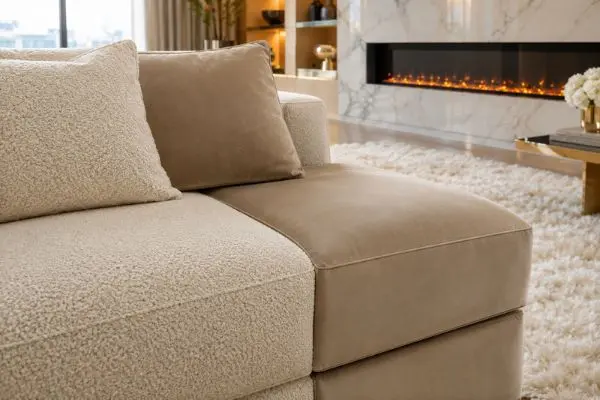
The material you choose affects comfort, appearance, cleaning effort, and long-term value. Your reversible chaise sofa should suit the way your household lives, not just look beautiful in a photograph.
Fabric upholstery offers a wide variety of colors, patterns, and textures. Cotton blends, polyester fabrics, microfiber, and performance textiles may suit different budgets and lifestyles. However, stain resistance, durability, and cleaning requirements vary depending on the fabric and finish.
Leather upholstery can be easier to clean than many fabrics, but it requires proper care. Different leather finishes react differently to moisture, cleaners, sunlight, and scratches. Always follow the manufacturer’s instructions.
Velvet and textured fabrics can add visual interest and a soft feel to your room. Depending on the material, they may require more attention to brushing, fabric crushing, dust, or pet hair.
When comparing sofa frames, look for clear information about construction. Kiln-dried hardwood, quality engineered wood, and well-designed metal components can all be used in furniture construction. The material name alone does not prove quality; joinery, support design, manufacturing, and warranty terms are also important.
Cushions deserve equal attention. High-resilience foam, fiber filling, feather blends, and layered constructions can feel very different. Firmer cushions may provide a more structured sitting position, while softer cushions may feel more relaxed. Neither option suits everyone.
If possible, sit on the sofa for a few minutes. Check whether your feet rest comfortably on the floor, your lower back feels supported, and you can stand up without excessive effort. Test the chaise as well as the regular seats.
Finally, inspect the connection between the chaise and the main sofa. Both pieces should align correctly, and the manufacturer’s instructions should explain how they stay in position.
For a broader comparison of furniture styles, read CozySofaHub’s living room sofa set buying guide.
How to Buy a Reversible Chaise Sofa With Confidence
Buying a sofa wisely starts with a clear budget and a list of requirements. Set your maximum spending limit before you start shopping so decorative features do not distract you from essential details.
Compare different models using the same criteria. Check the complete dimensions, included components, upholstery specifications, frame construction, warranty, delivery costs, and return conditions.
Pay special attention to the word reversible. Ask the seller to confirm that the exact model and configuration you want to order can be converted after delivery. If the listing includes photographs of both arrangements, verify that the same product you are purchasing supports both configurations.
The Sofa Buying Checklist
Use this checklist before placing your order:
- I have measured the room and delivery route.
- I have checked both chaise configurations.
- I have confirmed the exact product dimensions.
- I have verified how the chaise changes sides.
- I have checked the frame and support construction.
- I have tested the comfort of the seat and chaise, if possible.
- I have reviewed the upholstery cleaning instructions.
- I have confirmed the included cushions and components.
- I have read the warranty and return policy.
- I have checked delivery, assembly, and furniture removal costs.
Do not assume that a low price means poor quality or that a high price guarantees excellent construction. Instead, compare the available information and evidence for each model.
Also check whether the sofa has removable covers, replaceable cushion inserts, or available spare components. These features may make future care and repairs easier.
If your household needs reclining features rather than a movable chaise, compare their requirements carefully. A small reclining sofa uses a different mechanism and may require extra clearance when its footrest extends.
The best reversible chaise sofa is the one that fits your room, supports your preferred sitting position, and provides clear information about construction and care.
Cleaning and Maintaining Your Reversible Chaise Sofa
Regular maintenance helps preserve your sofa’s appearance and reduces the buildup of dust, crumbs, and everyday dirt. Your cleaning routine should match the upholstery rather than use the same method for every material.
Start by checking the manufacturer’s care label or product instructions. If the fabric has a specific cleaning code, follow it. Do not assume that every removable cover is machine-washable or that every fabric can tolerate water.
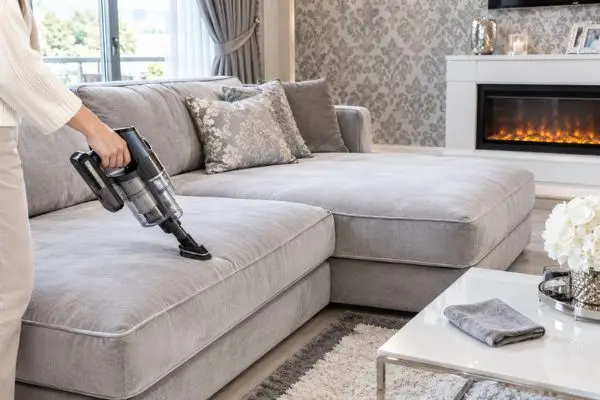
For routine care, vacuum the seat, back cushions, chaise surface, and crevices using a suitable upholstery attachment. Remove loose debris before it becomes trapped in the fabric.
When something spills, act promptly. Blot the area gently with a clean cloth instead of rubbing it aggressively. Rubbing can spread the spill or damage some fibers. Use a cleaning product only if the manufacturer permits it, and test it in a hidden area first.
Keep the sofa away from prolonged direct sunlight whenever possible. Strong sunlight can fade some fabrics and finishes over time. Rotate or rearrange removable cushions only if the manufacturer allows it; not every cushion is reversible.
The moving parts also need attention. When changing the chaise’s side, remove loose cushions and follow the approved conversion steps. Avoid dragging heavy components across the floor because this can damage the flooring or put pressure on the connections.
A Simple Sofa Maintenance Schedule
| Frequency | Action | Purpose |
| Weekly | Vacuum the seats, crevices, and chaise | Removes loose dust and crumbs |
| As needed | Blot spills and follow approved cleaning instructions | Reduces the chance of permanent stains |
| Monthly | Inspect cushions, seams, and connections | Helps identify movement or wear early |
| Every few months | Check the frame and hardware for looseness | Helps identify problems before they worsen |
| When changing the layout | Follow the manufacturer’s conversion instructions | Reduces the risk of damage or incorrect assembly |
If the sofa starts wobbling, makes unusual noises, or develops a loose connection, stop using the affected mechanism until you identify the cause. Contact the manufacturer or a qualified furniture repair professional if necessary.
Avoid forcing connectors into place, applying unapproved lubricants, or tightening hardware without checking the instructions. Proper care means preventing damage as well as cleaning visible dirt.
Common Buying Mistakes to Avoid
Even a well-designed reversible chaise sofa can disappoint when buyers overlook practical details.
Mistake 1: Trusting product photographs alone. A staged image cannot confirm that the chaise moves to both sides. Check the written specifications and conversion instructions.
Mistake 2: Measuring only the sofa’s width. The chaise can extend much farther into the room than the regular seats. Measure the complete footprint in both arrangements.
Mistake 3: Ignoring the delivery route. Doorways, stairs, and narrow hallway turns can prevent delivery. Ask for the dimensions of the largest individual component.
Mistake 4: Choosing appearance over comfort. Attractive upholstery and a modern design cannot compensate for a seat that feels too deep, too firm, or insufficiently supportive for your needs.
Mistake 5: Assuming every cushion can be flipped. Some cushions have only one finished side, attached fabric, or a shape designed for one position. Follow the manufacturer’s instructions.
Mistake 6: Overlooking maintenance. A light-colored fabric, delicate texture, or special finish may require more care than your household can comfortably provide. Choose a material that suits your routine.
Mistake 7: Forgetting the return policy. Confirm whether the seller accepts returns after assembly, who pays for return shipping, and whether a restocking fee applies.
Mistake 8: Treating reversibility as proof of quality. A movable chaise is a useful feature, but it does not prove the quality of the frame, cushions, upholstery, or hardware.
Mistake 9: Skipping the second-layout test. A sofa may fit perfectly with the chaise on the left but block a walkway when the chaise moves to the right. Test both positions before buying.
Avoiding these mistakes helps you focus on practical value rather than marketing language. A carefully selected sofa should suit your daily routine as well as your room.
Styling Your Reversible Chaise Sofa for a Balanced Living Room

Once you have made the practical decisions, styling can help the sofa feel like a natural part of your home.
Start with the room’s focal point. This might be a television, fireplace, window, or artwork. Position the sofa so people can enjoy that feature without creating awkward viewing angles or blocking essential pathways.
In a small living room, choose a coffee table that leaves enough space for movement. A table with rounded corners may help in tight layouts, while nesting tables can provide extra surface space when needed.
A rug can define the seating area and connect the sofa with nearby furniture. Choose a rug size that works with the sofa’s complete footprint rather than just the regular seating section.
Use cushions and throws to add color and texture, but do not fill the chaise with so many accessories that it loses its main purpose. A side table and reading lamp can turn the extended section into a comfortable reading spot.
For a calm, modern interior, consider neutral upholstery with a few contrasting accents. For a more expressive room, choose a deeper sofa color and keep the surrounding furniture relatively simple.
A reversible design lets you experiment with the layout, but you do not need to move the sofa constantly. Choose an arrangement that supports everyday activities, then change it when your needs genuinely shift.
If you like textured upholstery, CozySofaHub’s boucle sofa guide offers another starting point for exploring fabrics and interior styles.
Frequently Asked Questions
1. What Is a Reversible Chaise Sofa?
A reversible chaise sofa is a sofa whose extended lounging section can be moved from one side to the other. The exact method depends on the model and may involve a movable ottoman, detachable chaise section, or modular components. Check the product instructions to confirm that both configurations are supported.
2. Is a Reversible Chaise Sofa Good for a Small Living Room?
Yes, it can work well in a small living room if its dimensions leave enough comfortable space for walking. Measure the complete footprint in both configurations, including the chaise depth. A reversible design offers flexibility, but it does not automatically make an oversized sofa suitable for a small room.
3. How Do You Change the Side of a Reversible Chaise Sofa?
Follow the manufacturer’s conversion instructions. Depending on the model, you may need to move the ottoman or chaise section, reposition cushions, and reconnect components. Remove loose items first, protect the floor, and ask for help with heavy pieces. Never force a connector into place or use a configuration that the manufacturer does not support.
4. Which Upholstery Is Best for a Reversible Chaise Sofa?
The best upholstery depends on your budget, comfort preferences, and household needs. Durable fabric blends may suit busy living rooms, while leather can provide a surface that is easier to wipe clean. Check the manufacturer’s cleaning guidance, wear information, and material specifications before making your choice.
5. Can a Reversible Chaise Sofa Last for Many Years?
Yes, a well-constructed sofa can last for years, but its lifespan depends on frame quality, cushion materials, upholstery, usage, and maintenance. Inspect the construction and warranty before buying, clean the sofa according to the care instructions, and address loose connections or damaged cushions promptly.
Conclusion
A reversible chaise sofa can be a practical choice when you want comfortable lounging space without limiting your living room to one permanent arrangement. Its biggest advantage is flexibility: you can move the chaise to the other side when your furniture layout changes, provided your specific model supports this conversion.
However, choosing the right sofa involves more than selecting a stylish shape. Measure your room carefully, test both configurations with painter’s tape, and check the delivery route before ordering. Pay attention to seat support, cushion construction, upholstery care, frame quality, and the stability of the chaise connection.
Use the buying checklist in this guide to compare products using the same criteria. Confirm the manufacturer’s instructions, warranty, return policy, and included components instead of relying only on photographs or the word reversible.
After delivery, protect your investment through regular vacuuming, prompt spill cleaning, and proper handling whenever you change the layout. Avoid cleaning products or adjustments that the manufacturer does not approve.
Most importantly, choose furniture that suits your lifestyle. A well-matched reversible chaise sofa should provide a comfortable place to relax, a layout that supports easy movement, and enough flexibility to remain useful as your home’s needs change. Take your time to measure, compare, and test your options before buying. This preparation can help you make a confident purchase that feels right in everyday life.

Tanzeela is a furniture and home interior writer at CozySofaHub. She writes practical guides about sofas, living room furniture, sofa care, and home interiors to help readers make confident furniture-buying decisions.


